
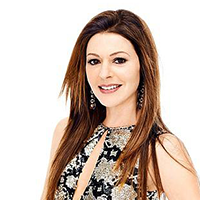
Frasier's English Rose
Jane Leeves gave up dancing on cruise liners for a one-way ticket to Hollywood. The British star of America’s best-loved television sitcom tells William Cook why she went west.
Seeing an episode of Frasier performed live in Los Angeles is an oddly communal experience. The stalls are filled with fans who have queued to get close to Hollywood’s highest-brow sitcom, but there are almost as many backstage staff eavesdropping on a show that demolishes every fondly held British preconception about Americans and irony.
“The differences between our humor aren’t that great,” explains Jane Leeves, the show’s lead actress. She is sitting on a sofa in her smart, sunlit office at Paramount Pictures, just round the corner from the Frasier set. “The British tend to get a bit more toiletty and potty, and also we’re more apt to make fun of ourselves than Americans are, but we really do laugh at the same things.”
Leeves should know. As Daphne Moon, the show’s daffy Mancunian physiotherapist, the long-legged 38-year-old is the best known British comic actress in American television. In the nine years she has played the warm-hearted foil to the high-falutin’, highly strung Crane brothers, rival psychiatrists Frasier and Niles, she has probably done more to modify the stereotypical Hollywood image of British snootiness than any performer alive.
Her secret? She’s pretty – tall and slim with a dancer’s poise – but there’s never been any shortage of pretty girls in Los Angeles. No, Leeves, and engineer’s daughter from East Grinstead who reached the peak of her British career as a Benny Hill girl in the early 1980’s, must have something else, something that this side of the Atlantic just never appreciated – until Frasier showed us just what we’d let slip through our fingers.
Her soft, classless mid-Atlantic accent is in stark contrast to Daphne’s Mancunian twang. She’s also far more glamorous and confident than Daphne and so she should be. She has a smart Malibu house, and her own production company. She’s been invited to the White House. And then there’s the salary. Frasier costs $5.2 million per 30-minute episode – and much of that goes to the actor: even after Kelsey Grammar, who plays Frasier, gets $1 million and David Hyde Pierce as Niles gets $700,000, there’s still enough to pay the rest of the cast six-figure sums each for every show.
“It’s so funny when English actors come over here. They are very established in England and they look at was this sort of strange phenomenon. They’re like ‘Well, how did you do this? I’ve got this career going in England, I come here and I can’t do it.’ And I say, ‘Well, I had nothing to lose when I came here. You’ve got a career to lose over there, you have to get back there in a few months before they forget you.’” But Leeves stayed on – and her staying power and paid rich dividends. “Frasier has been the greatest experience of my life. It’s given me everything. It’s given me security. It’s given me my husband, my daughter”
She’s not exaggerating. David Hyde Pierce – her on-screen lover after one of the longest crushes in TV history – introduced her to her real-life husband, Paramount Executive Marshall Coben and half the sitcom’s class flew over to see them marry in 1996. Her pregnancy last year, she says, “threw a spanner in the works” for the show’s scriptwriters – since she and Niles had only just got it together after seven years of will-they-won’t-they – but the producers simply ignored the evidence and wrote in a weight problem instead.
Not every show would be so accommodating – or give her daughter, Isabella, so warm a welcome when she first appeared on set, aged only one month. “It’s a weekly rep thing, I’ve been with these people for so long, they’re family. There’s a chemistry between all of us that was right there from the start.”
This chemistry was put to the test on September 11, when plans to record a new episode were cancelled in the wake of the World Trade Centre disasters. “So many people are going to be killed in this – we’re probably going to know somebody,” warned her husband. He was right: David Angell, the show’s creator, and his wife Lynn were in one of the hijacked planes. “You just go into shock,” says Leeves. “These are the dearest, sweetest people and they’re friends and it still doesn’t seem real. We still feel like we’re going to see them again.”
The following Sunday, Leeves arrived at the memorial wondering how she was going “to get through this”, but David Lee, who created Frasier with Angell, set the tone. “I want you to leave your sorrow at the door. We’ll have no Amazing Grace played on the bagpipes. When has that ever bene a comfort anyway?”
Instead, those who knew David and Lynn told funny stories for the next 90 minutes. “It was such a celebration of them and you realize the power of laughter. It sort of made it OK to go back to work the next day and film the next show.” Ever since September 11, she adds, audiences have “been craving to laugh and be entertained. People just want to get back to normal.”
Her talk of family, of “normality”, inevitably raises comparisons with her East Grinstead upbringing – where money was so tight her parents couldn’t afford to indulge in little Jane’s longing to go to a school specialising in drama and dance. “I don’t remember wanting to do anything else,” she says. “I used to have one ballet class on Saturday mornings at 12 o’clock but I would get there at 10 and stand outside the door and just watch.”
Her persistence paid off with a scholarship. “I was really behind everyone else because they’d been there for years,” she recalls. “Yet within six months I had caught up and overtaken.” There’s no self-congratulation in her voice but not false modesty either. “I worked harder than anybody else.” She says simply.
The same youthful singlemindedness propelled her through a series of setbacks -including a leg injury that killed her hopes of a career in classical ballet. “It was, oh right, now I’ll be an actress. America, that’s where you go to be an actress, so that’s what I’ll do.”
She laughs at her naivety, but she clearly marvels at the guts that made her 21-year-old self throw over a scrappy career of cruise-ship dancing, Benny Hill and Morecambe and Wise in favor of a one-way transatlantic ticket. “I never allowed myself a back-up. I sold the tiny bit of furniture I had. A thousand dollars, my suitcase, and I said to myself I’m not coming back home until I’ve made it.”
And make it she did – after 18 months of “the whole starving artist” routine. Jobs in a factory, as a babysitter, a souvenir salesgirl, funded her acting classes, but she didn’t always have money to eat lunch with the other students — who included Jim Carrey, Ellen DeGeneres and Winona Ryder. Eventually, the big break came with a role in Murphy Brown and a memorable appearance on Seinfeld, which persuaded the Frasier team to change their female lead from Puerto Rican to English.
Frasier was an instant hit, winning 16 Emmy’s in its first five years. And Jane Leeves was suddenly a name to be taken very seriously indeed – although she’s taken time to realise it. “Even after several years, you’re still worried that you’re going to get fired and that you’re not doing very well, but I think now we’re beginning to relax and think: Okay this show’s going to last, it’s a hit.”
Would she have achieved anything like the same success if she’d stayed in Britain? “I don’t know. There was always the sense that you had to go to Rada, that you had to be somebody’s daughter and that certainly nobody like me would be given a look in.”
So is there anything English about her these days – apart from the passport? “I suppose I’m really a true American,” she concedes. “I came over on a 747, not the Mayflower, but it’s the same kind of thing, I guess. I have that drive, that go-get it American thing.” She pauses. “Well I did have it, I don’t so much now… because I went and got it.”
Professional success has evidently mellowed her – but she credits motherhood and marriage for the real transformation. “Because I’ve got Isabella and Marshall, nothing can hurt me, I’ve got that safety net at home. That’s all that matters. Before, it was as if I was obsessed with doing the right thing on the show – but now I’m more willing to take a risk,” she laughs as she says it, but deep down you sense she really means it. “I’ve got them.”